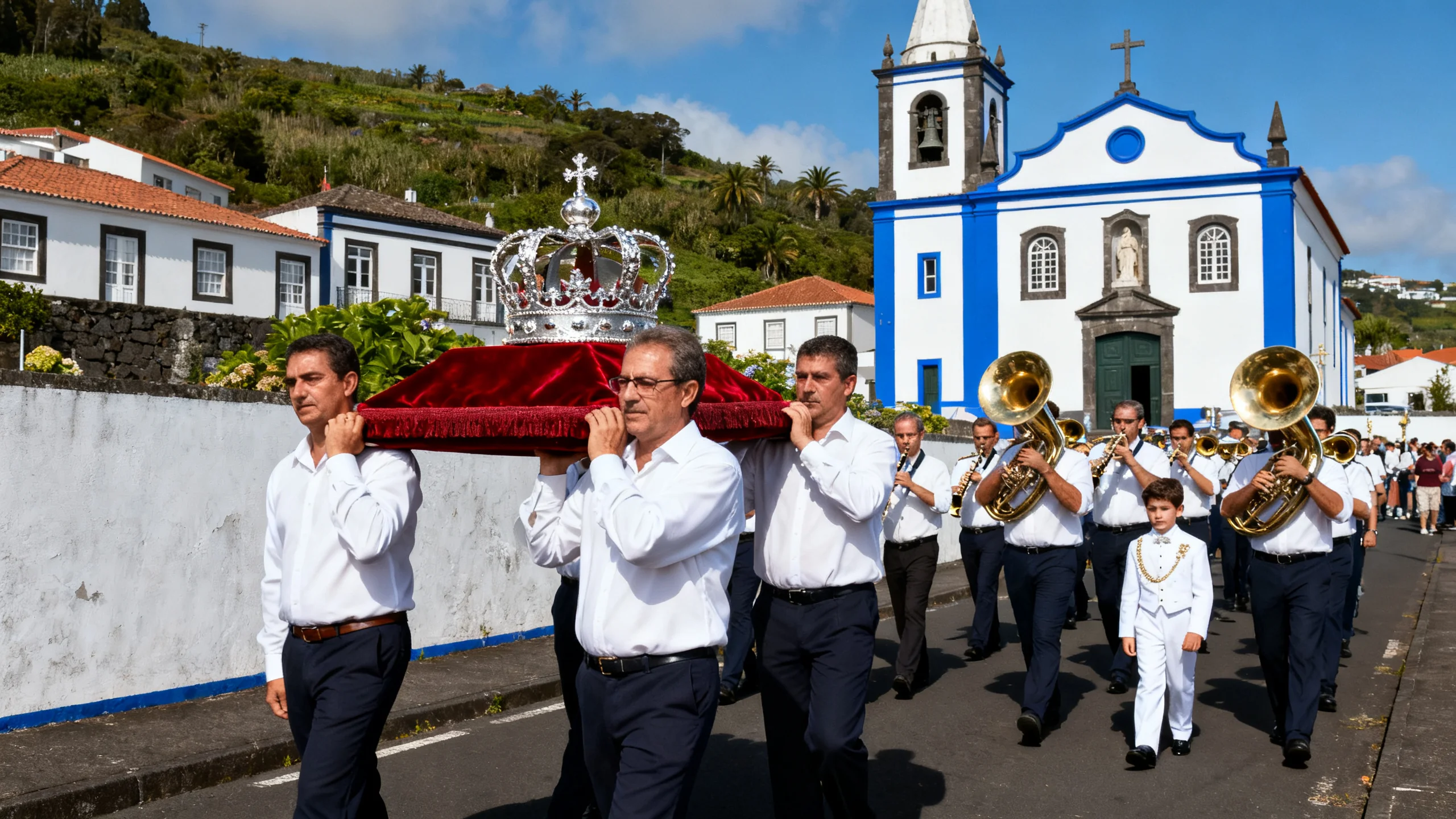
Forty Sunday processions, free meals for thousands, a crown that travels village to village. The Festas do Espírito Santo are the most distinctive cultural event in the Azores, and tourists rarely understand what they are seeing.
Between Pentecost and the first Sunday of September, almost every village in the Azores hosts a Festa do Espírito Santo. The celebration involves a silver crown carried in procession, a free public meal for hundreds or thousands of people, a brass band, and a temporary throne (the império) in the village square. To a visitor passing through, it looks like a strange church festival. It is something else.
This guide covers what the festas actually are, the history behind them, the calendar that determines which village hosts when, and how a curious tourist can watch one respectfully.
What the festa actually is
A village (or a parish, or a confraria, a brotherhood) elects one man as imperador for the year. The imperador’s job is to host the festa: to organise the procession, to feed the village, and to carry the crown.
The crown (the coroa) is silver, about 30 centimetres tall, a stylised imperial crown topped with a dove. It is the central object of the festa. Each village or brotherhood has its own crown, stored in the local church or in a dedicated chapel.
On the festa Sunday, the imperador’s household carries the crown in procession to the village church for a special Mass. After Mass, the crown is enthroned in the império (a small white chapel-like building in the village square, painted in pastels, used only for this purpose) for the rest of the day. In the afternoon, the village hosts a free communal meal, usually sopas do Espírito Santo (a thick beef-and-bread soup) plus carne assada (slow-roast beef) and red wine.
The meal is open to everyone. Locals. Visitors. Strangers who happen to drive through. The whole point of the festa is the deliberate, ritualised generosity.
The history, in three paragraphs
The Festas do Espírito Santo trace back to medieval Portugal, brought to the Azores by the first settlers in the 15th century. The original theological grounding is the cult of the Holy Spirit, expressed through the imagery of Queen Isabel of Portugal (1271 to 1336) who is said to have given her crown to the poor.
On mainland Portugal, the tradition has largely faded. In the Azores, it survived because the islands were isolated and the festa was the central organising principle of village life. The free meal was particularly important on islands where harvests varied and the poor often relied on the imperador’s charity to get through a lean spring.
Today the religious component remains but the social and cultural elements are what most participants stress. The festas are about village solidarity, the rotation of obligation across families, and a yearly reminder that the village holds together by sharing the hard work.
The calendar
The festas happen on Sundays from Pentecost (50 days after Easter, typically late May or early June) through the first Sunday of September. About 200 festas are held across the archipelago during this window.
| Period | Approximate festa count |
|---|---|
| Pentecost weekend | 30 to 40 villages simultaneously |
| Each Sunday May to September | 5 to 15 villages each Sunday |
| First Sunday of September | Final festas of the cycle |
Most villages host one main festa per year, plus smaller neighbourhood ones. The biggest celebrations are on Terceira (the Sanjoaninas in June overlap with the festas) and on São Jorge where the festa cycle is particularly elaborate.
What a visitor sees
A typical festa Sunday in a village runs like this.
| Time | What happens |
|---|---|
| 9:30 | Procession leaves the imperador’s house, brass band, crown on cushion. |
| 10:00 | High Mass at the village church, crown enthroned on the altar. |
| 11:30 | Procession to the império, crown installed for the day. |
| 12:00 | Communal lunch begins, sopas do Espírito Santo served in long rows. |
| 14:00 | Carne assada and red wine, music in the square. |
| 18:00 | Crown returned to the church or chapel. |
| 19:00 | Communal dinner, dancing, fireworks. |
The whole village is in the streets. Almost every house contributes food or wine. The imperador and his immediate family eat last, after everyone else has been served.
The food
Three dishes are central to the festas, and the recipe for each is guarded but broadly standardised.
Sopas do Espírito Santo. A thick beef-and-bread soup. Slices of massa sovada (the local sweet brioche) are arranged in deep bowls, then ladled with a rich beef broth flavoured with cinnamon, mint and cloves. Beef chunks and bay leaves on top. A particularly Azorean dish (rare on the mainland) and a calorie-dense one.
Carne assada. Slow-roasted beef, traditionally cooked overnight in a community oven. Served with potatoes and a wine-vinegar sauce.
Massa sovada. The sweet bread itself, baked in large round loaves for the festas. A small loaf is given to each family who participates.
The food is the same across most islands; the regional variations are subtle. The Terceira version of sopas adds a heavier spice mix than the São Miguel version. The Pico version sometimes substitutes goat for beef.
Frequently asked questions
Can I just walk in and eat?
Yes. The whole point of the festa meal is to feed everyone present, including strangers. Show up at the village square around noon, ask locally where to sit, accept the soup. Leave a small donation. The village welcomes outsiders genuinely; this is not a token gesture.
How do I find which village is hosting on a given Sunday?
Local tourist offices publish the festa calendars in May. The visitazores.com regional sites list confirmed festas by date and village. Hotel receptions on the smaller islands often know which village is hosting that week. Drive out into the countryside on any Sunday between Pentecost and September, and you will probably encounter one.
Is it OK to take photos?
Discreetly, yes. Avoid the procession from the front (the imperador’s family is being photographed enough). Avoid people eating without asking. The crown itself is photographable from the side. Brass bands love being photographed. Long lenses are preferred over flash. As with any local religious event, common sense rules.
Is it tourist-friendly or really for locals?
Both, genuinely. The festa is structurally a village event, but the village extends its hospitality to whoever happens to be present. Tourists are welcome, not catered to. You are watching something that would happen identically whether you were there or not, which is precisely what makes it worth attending. The Disneyland version does not exist.
What is the relationship to the Sanjoaninas?
The Sanjoaninas is Terceira’s main summer festival (early to mid June, in honour of Saint John the Baptist). It overlaps with the Espírito Santo cycle and shares some of the same parade elements, but it is structurally a separate, more theatrical municipal event: parades, bullfights, concerts, food stalls. The Sanjoaninas is the big Terceira summer party. The Espírito Santo festas in Terceira villages run alongside it and continue afterwards.