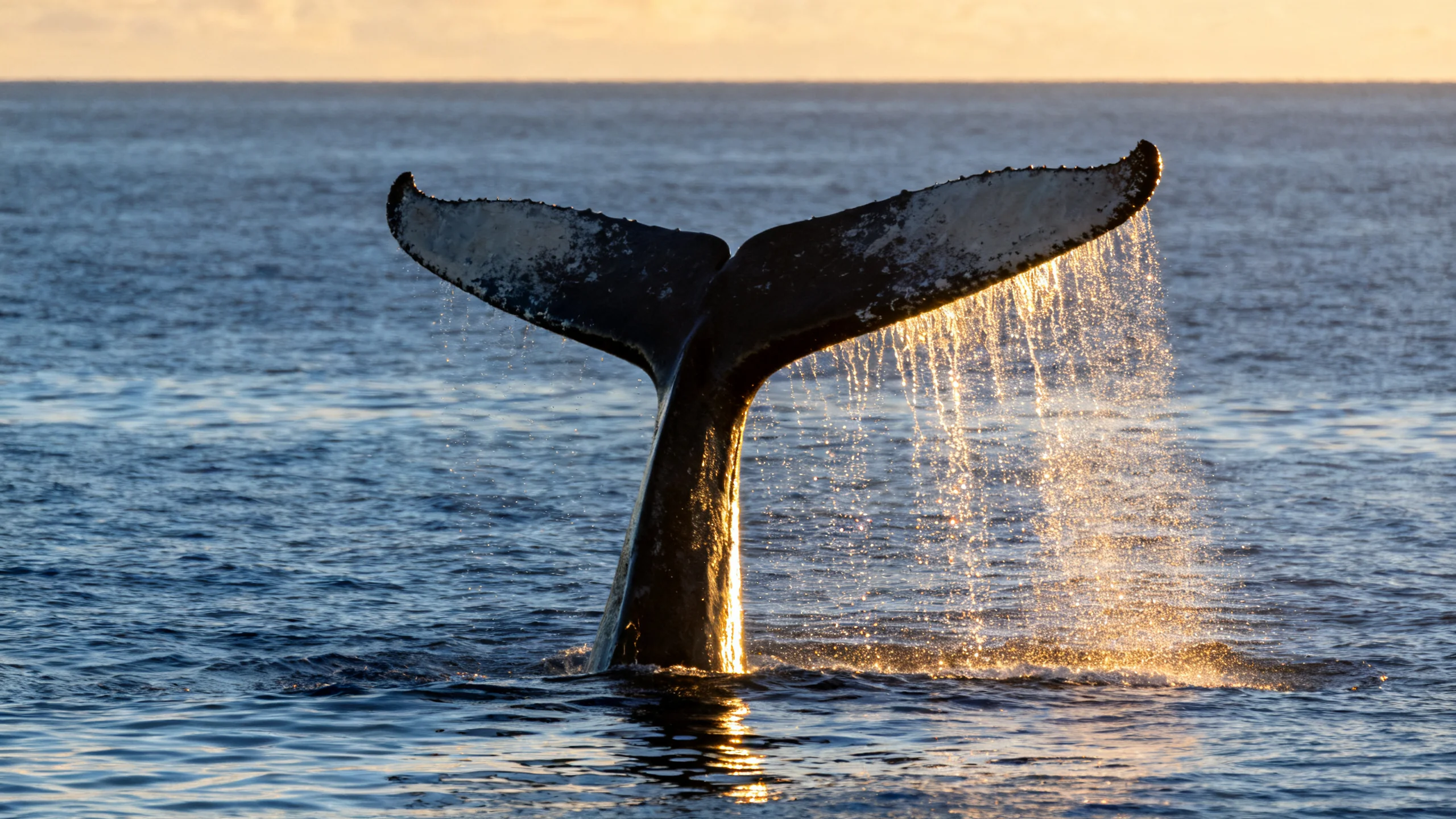
A complete guide to the cetacean species recorded in Azorean waters. The eight common ones, the rare visitors, the seasonal blue whales, and how to identify each from a watching boat.
The Azorean waters host 24 documented cetacean species, more than anywhere else in Europe. The combination of deep-water geography (the seabed drops to 3,000 metres a few kilometres offshore), the mid-Atlantic position on the migration corridor, and the Gulf Stream nutrient flow makes the archipelago a genuine whale capital.
This guide covers the species you can realistically see from a watching trip, the rare sightings, the identification basics, and the seasonality that determines what shows up in which month.
The big picture
| Group | Species count | Most visible |
|---|---|---|
| Toothed whales | 8 | Sperm whale |
| Baleen whales | 6 | Fin, blue, sei |
| Beaked whales | 5 | Sowerby’s, Cuvier’s |
| Dolphins | 5 | Common, bottlenose |
Almost any whale-watching trip out of Ponta Delgada, Lajes do Pico, or Horta will encounter two to four species. The most reliable year-round sighting is the sperm whale. The seasonal blue whale migration (April to June) is the European bucket-list event.
The eight species you most often see
1. Sperm whale (Physeter macrocephalus)
The Azorean signature whale. Resident population of around 200 to 300 individuals, the same matriarchal families documented in researcher catalogs since the 1980s. Large (males 16+ metres, females 11 metres), distinctive blocky head, single asymmetric blowhole on the left side.
Behaviour: deep dives lasting 30 to 60 minutes, surface windows of 8 to 12 minutes between dives. The classic Azorean sighting is a sperm whale group spouting at the surface, then fluking and disappearing for an hour.
Best season: year-round, particularly stable May to October.
2. Common dolphin (Delphinus delphis)
The most numerous and most visible cetacean. Pods of 50 to 300 animals, very active, love to bow-ride the boats. Yellow flank patch makes them easy to identify even at distance.
Best season: year-round, peak abundance June to September.
3. Bottlenose dolphin (Tursiops truncatus)
Larger than the common dolphin, all-grey body, no flank patch. Resident pods of 20 to 60. Less acrobatic, more curious, will often swim alongside boats at slow speeds for long stretches.
Best season: year-round.
4. Risso’s dolphin (Grampus griseus)
Pale grey with characteristic white scratches across the body (from intra-species scarring). Squid-eaters, smaller pods of 5 to 30, slower swimmers. The Azores hosts an exceptionally large Risso’s population.
Best season: year-round, but most observable in calm seas (June to September).
5. Atlantic spotted dolphin (Stenella frontalis)
Seasonal visitor only. Distinctive dark and light spotting pattern that develops with age. Smaller and faster than common dolphins, particularly acrobatic. Pods of 20 to 80.
Best season: June to October.
6. Fin whale (Balaenoptera physalus)
The second-largest animal on earth (males up to 24 metres). Long sleek body, distinctive asymmetric jaw colouring (white on the right, dark on the left). Pass through Azorean waters on their spring migration from low to high latitudes.
Best season: April to June.
7. Blue whale (Balaenoptera musculus)
The largest animal that has ever existed (up to 30 metres, 180 tonnes). Visits Azorean waters during the spring migration. The Azores is the most reliable European waters for blue whale sightings, with 30 to 60 documented annual encounters.
Best season: April to early June, peak in the second half of May.
8. Sei whale (Balaenoptera borealis)
Smaller cousin of the fin and blue (up to 16 metres). Distinctive single sharp dorsal fin, fast swimmer. Spring migrant through Azorean waters.
Best season: April to June.
The five less-common sightings
These appear occasionally but cannot be planned for.
Pilot whale (Globicephala melas)
A medium-sized toothed whale (5 to 7 metres), all black, bulbous head, pods of 20 to 80. Year-round but irregular.
False killer whale (Pseudorca crassidens)
Despite the name, a large dolphin (up to 6 metres). Black, slender, fast. Pods of 10 to 30. Rare in Azorean waters but documented several times a year.
Killer whale, orca (Orcinus orca)
A few documented Azorean visits per year. The animals are usually travelling through rather than resident.
Sowerby’s beaked whale (Mesoplodon bidens)
A medium beaked whale (5 metres), elusive deep-diver. The Azores is one of the few reliable sighting locations in the North Atlantic.
Cuvier’s beaked whale (Ziphius cavirostris)
Similar habits to Sowerby’s but slightly more frequent. Both species dive to 2,000+ metres on hour-long hunts.
How to identify what you are looking at
The four key features whale-watching guides train you on.
| Feature | What to look for |
|---|---|
| Blow shape | Vertical (sperm leans left), V-shaped (right whale), bushy |
| Body size | Estimate against the boat or other reference points |
| Dorsal fin | Tall (orca), small (sperm), small triangular (fin/blue) |
| Surface time | Long stays (sperm), brief breaches (most baleen) |
The marine biologist on board does most of the identification for you. Asking why they made the call (rather than just what species it is) is the way to learn.
Frequently asked questions
Can I just go to the cliffs and see whales?
Sometimes, especially during spring migration. The Vigia da Baleia above Lajes do Pico is the famous land-based watching tower, used by the old whalers and now by researchers. Sperm whale spouts are visible from the cliffs there in the right conditions, though distant. For a real encounter, you need to be on a boat.
What is the difference between watching from São Miguel and Pico?
Pico has the steepest underwater drop-off in the archipelago. The boats reach deep water (where sperm whales feed) in 20 minutes instead of an hour. Encounters tend to be closer and longer. São Miguel has more departure options and easier logistics. Both are excellent. See the whale watching fiche for operator recommendations.
Are the populations growing or declining?
Mixed. Sperm whale numbers have been stable or slightly increasing since whaling stopped in 1984. Blue whale and fin whale populations in the North Atlantic are slowly recovering from 20th-century whaling lows. The dolphin populations seem stable. The bigger threats today are vessel strikes, plastic pollution, and acoustic disturbance from offshore shipping.
Where do the sperm whales go between dives?
Down to 800 to 1,200 metres to hunt giant squid. They dive nearly vertical, hunt for 30 to 60 minutes in total darkness using echolocation clicks audible underwater for several kilometres, then surface to recover oxygen. The surface windows are when watching boats can encounter them; the dives are why you have to wait so long.
Have any new species been discovered recently?
Several new sightings have been added in recent decades through research expeditions, mostly beaked whales and rare migrants. The University of the Azores marine biology department maintains the official species list. The Azores remains one of the most actively surveyed marine mammal habitats in the world.