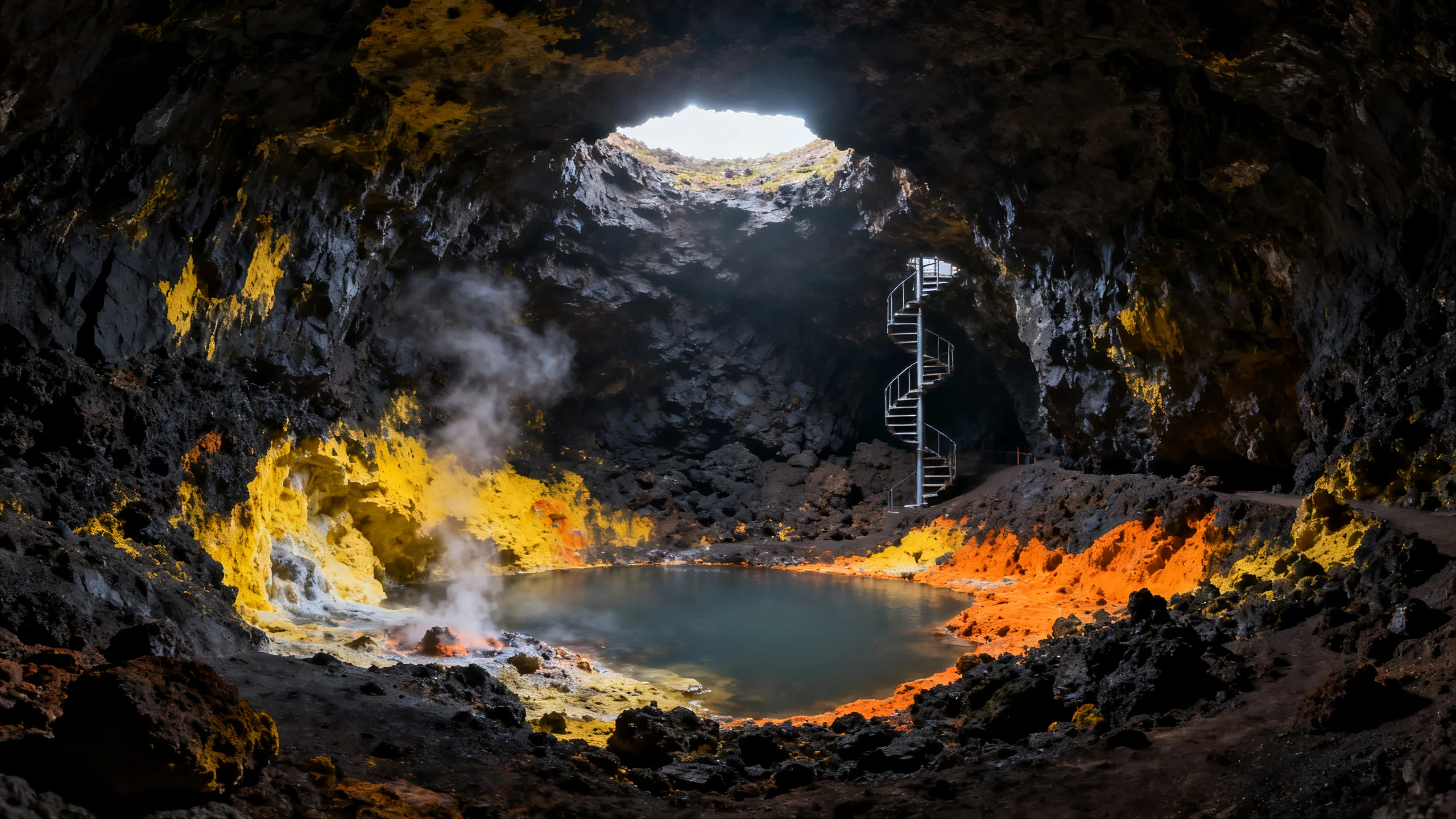
Furna do Enxofre
A 220-metre-deep cavern with an underground lagoon and an active fumarole field at its base. The only sulphurous cavern of its kind in Europe, the central reason most visitors come to Graciosa, and one of the most distinctive geological sites in the Azores.
What it is, geologically
Furna do Enxofre sits inside the Caldeira do Estrondo, the central volcanic crater of Graciosa. The cavern is a magmatic gas chamber that formed when superheated steam and sulphurous gases hollowed out a void in the rock beneath the caldera floor. The collapse of the ceiling created the cavity we visit today.
At the bottom, 220 metres below the rim entrance, sit:
- A small underground lagoon of cool freshwater (around 14 °C year-round)
- Active fumaroles emitting sulphurous gas (H₂S and CO₂)
- Yellow sulphur deposits crystallised on the basalt walls
- A small mudpot bubbling at the lagoon edge
The gases give the cavern its distinctive rotten-egg smell and the yellow-orange staining on the walls. Air quality is monitored continuously by gas sensors; the visit is safe within standard tour parameters but the smell is unmistakable.
How to visit
| Item | Detail |
|---|---|
| Location | Caldeira do Estrondo, 15 min drive from Santa Cruz da Graciosa |
| Visitor centre hours | April to September: 10am to 5pm daily. October to March: 10am to 4pm, closed Mondays. |
| Entry fee | €5 adults, €2.50 children |
| Tour format | Self-guided after a short safety briefing. No mandatory guide. |
| Descent | 184 steps down a spiral staircase. Same back up. |
| Time at the bottom | Self-paced. Most visitors spend 20 to 40 minutes inside. |
| Total visit time | 60 to 90 minutes including the visitor centre exhibition |
| Booking | Walk-in. Tickets sold on the spot at the visitor centre. |
The descent
The entrance pavilion was built in 1939 as a modernist stone structure on the rim of the cavern. From the pavilion, the metal spiral staircase descends through a vertical shaft about 4 metres wide. The shaft is artificially lit; the natural opening admits a thin column of daylight from above.
The 184 steps are uniform, with regular landings every 20 to 30 steps. Handrails on both sides. The descent takes 5 to 8 minutes at a moderate pace; the climb back up takes 8 to 12 minutes. Trail runners do it in 3 minutes each way; older travellers and children take longer.
What you see at the bottom
The cavern opens into a roughly circular chamber about 40 metres across and 80 metres high. The shaft you came down opens into the ceiling near one edge.
The lagoon. Roughly 15 metres across, a metre deep at the centre. Cool, clear, very still. Looks black in the dim light. Marked off by a low railing; no swimming, no touching.
The fumaroles. Three or four small vents in the wall near the lagoon edge, emitting visible steam and a strong sulphur smell. The vent temperatures are around 60 to 80 °C, hot enough to feel from a metre away. Yellow sulphur crystals coat the rim of each vent.
The mudpot. A small basin of bubbling grey clay near the lagoon edge. Active throughout the day, louder in cooler air conditions.
The walls. Discoloured by mineral staining in yellows, oranges and ochres. The ceiling is darker basalt with stalactite-like drip features in some places.
Accessibility honest-talk
The 184-step descent is the limiting factor. The site is not wheelchair-accessible and not suitable for visitors with significant mobility issues. Children from around age 6 do fine; younger ones manage with parental supervision on the stairs. Pregnant visitors should consider whether the climb back up is reasonable for them.
Visitors with claustrophobia may find the descent uncomfortable. The shaft is 4 metres wide and well-lit but the sense of going underground is real. The chamber itself is large and feels open.
Asthma sufferers and visitors with respiratory conditions should consult their doctor before visiting; the sulphurous air is irritating even for healthy lungs in high concentrations.
What to bring
- Closed shoes with grip. The steps are dry but can be slippery. Sandals are not ideal.
- A light layer. The cavern is around 14 °C year-round, noticeably cooler than the surface in summer.
- Camera with a wide-angle lens. The dramatic scale is hard to capture on a phone. Tripod optional but allowed.
- Bottled water. No facilities at the bottom; the visitor centre has a small café.
- Nothing else needed. No torches (lit throughout), no helmets (not technical), no special gear.
Combining with the Caldeira rim trail
The same visitor centre is the trailhead for the 7-km Caldeira rim walk. The natural pattern is to do both on the same morning:
- 9:00 Visitor centre opens. Coffee at the café.
- 9:15 Descend Furna do Enxofre, 30 to 40 min underground.
- 10:00 Back up, brief at the visitor centre exhibition.
- 10:45 Start the Caldeira rim trail.
- 13:15 Return to visitor centre.
- 13:30 Lunch in Santa Cruz da Graciosa.
Total: half a day, covering the two main attractions of the island.