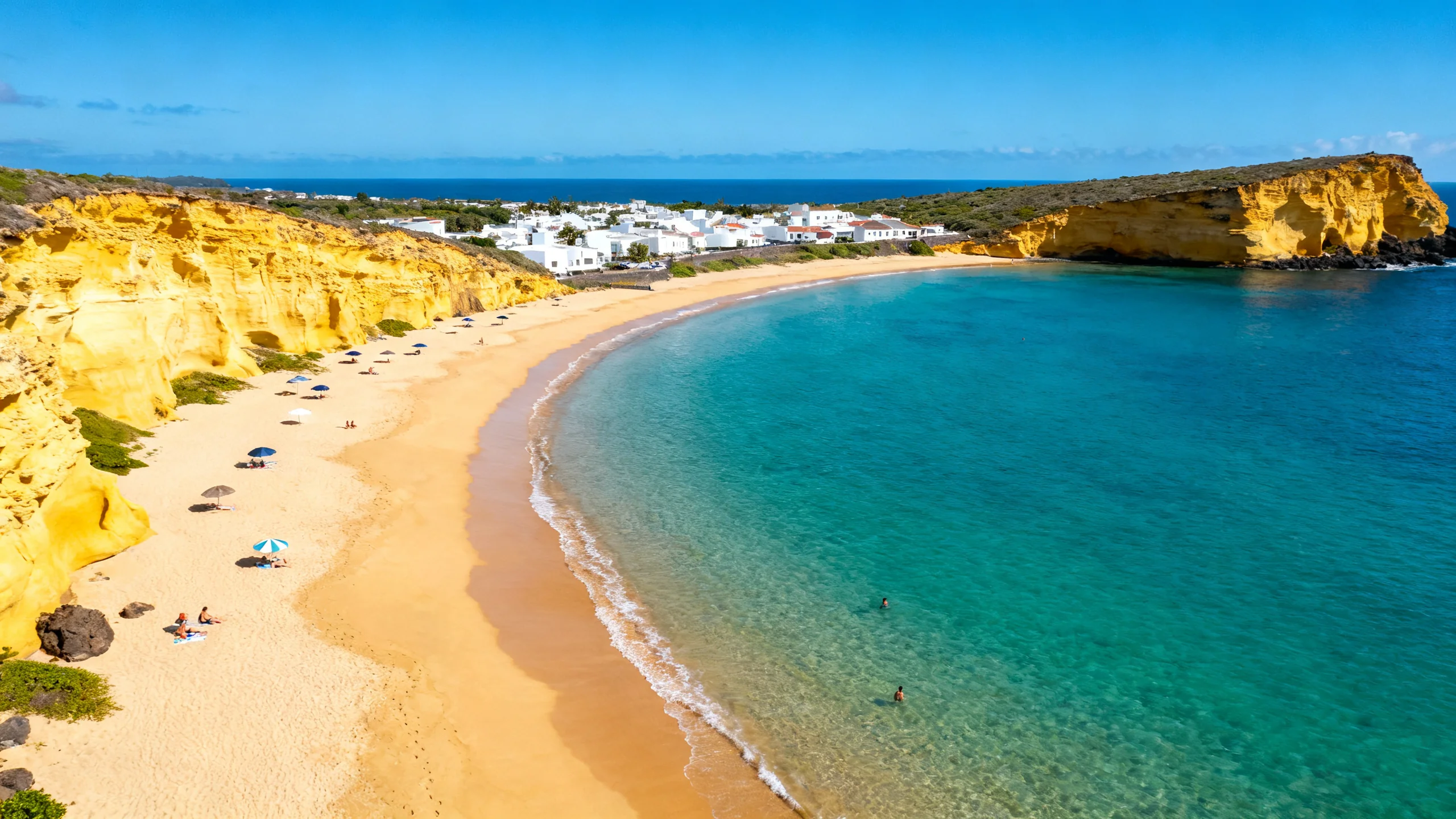
Santa Maria is the southernmost and oldest of the Azorean islands. Volcanic activity ceased on Santa Maria around 5 million years ago, long enough for the original lava to erode into fertile yellow-tinted soil and for the coastline to develop the only proper sandy beaches in the Azores. The climate is the driest and sunniest of the archipelago. The capital Vila do Porto is the oldest town in the Azores, founded in 1432, the first Portuguese settlement on the islands.
Santa Maria is the southernmost Azorean island, the smallest of the eastern group, and the oldest of the archipelago. Volcanic activity ceased here around 5 million years ago. The original basalt has weathered into chalky tuff and clay, the climate is significantly drier and sunnier than the rest of the Azores, and the coastline has developed the only proper sand beaches in the archipelago.
This guide covers what to expect, the beaches, the history of the old town, and how to plan a stay of 3 to 5 days.
Why Santa Maria
Santa Maria reads differently from the rest of the Azores. The landscape is yellow rather than green. The beaches are sand rather than rock. The light is brighter, the air drier, the sea calmer. The island is the closest the Azores gets to a beach destination.
It is the right pick for families who want sand-and-swim afternoons, sailors who want a sheltered anchorage, divers who want the manta ray reefs at Banco de Dollabarat, and history travellers interested in the oldest Azorean town. It is the wrong pick for travellers focused on dramatic volcanic landscape (try São Miguel, Pico, or Flores) or the more famous central-group island-hopping.
Santa Maria works as a 3 to 5 day standalone destination, or as a weekend extension from São Miguel via the 25-minute SATA flight.
Geography and climate
Santa Maria is 17 km long by 9 wide, oriented roughly east-west. The interior is gently undulating, with the central Pico Alto at 587 m. No active volcanoes; the deep weathering has produced a landscape of yellow tuff soils, cultivated terraces, and scattered small white-painted villages.
Vila do Porto is the capital, on the south coast at the western end. Santo Espírito, Almagreira, São Pedro, Santa Bárbara, and Maia are smaller villages scattered around the coast. The Santa Maria Airport is on the east coast, well separated from the population centres.
The climate is the driest in the Azores (30% less rainfall than São Miguel). The mean annual sunshine is 30% higher. The sea is the warmest in the archipelago (peaks at 24 °C in August). Winter is mild and significantly less rainy than the central group.
Top experiences on Santa Maria
Praia Formosa. The best beach in the Azores. A 700-metre curve of golden sand on the south coast, sheltered by basalt cliffs at each end, swimmable June to October, lifeguarded in summer. The island’s only real beach resort area. See the beaches of Santa Maria guide for the complete swimming map.
Vila do Porto. The oldest town in the Azores, founded in 1432 by the first Portuguese settlers. The historic centre runs along the cliff above the small natural harbour. Forte de São Brás (a 16th-century fortress, now a small museum), the Igreja Matriz church, the cobbled main square. Walking circuit: 1.5 hours.
Capela de Nossa Senhora dos Anjos. A small white chapel near the village of Anjos on the north coast, where Christopher Columbus stopped on 18 February 1493 to take Mass on his return voyage from the Caribbean. The chapel walls record the visit in a 16th-century inscription. Free, always open.
Pico Alto. The 587-metre summit at the centre of the island, reached via a 4 km drive from the EN1. The viewpoint at the top covers the whole island and on clear days the southern tip of São Miguel 80 km north. Free, always open.
The Santa Maria Airport history. Built in 1933 as a transatlantic seaplane stopover for the German Zeppelins, taken over as a US military base in WWII, civilian since 1945. The small aviation museum at the airport (€3 entry) covers the history with displays of original aircraft parts and 1940s photographs.
Maia village and the barreiro. A small village on the south coast known for the local pottery industry, which uses the yellow barreiro clay quarried inland. The Casa do Barreiro visitor centre demonstrates the traditional pottery technique. €4 entry.
Manta ray diving at Banco de Dollabarat. A submarine reef 40 km south of Santa Maria, the only reliable manta ray sighting location in Atlantic Europe. Specialist dive operators run trips from Vila do Porto from June to October, around €120 to €180 per dive day with two dives included.
Where to base yourself
Vila do Porto is the practical default. Most accommodation, the restaurant scene, the harbour with dive and sailing operators, the historic centre. Drive times from Vila do Porto: 10 minutes to Praia Formosa, 25 minutes to the airport, 20 minutes to Anjos and the Columbus chapel.
Praia Formosa has a small concentration of seasonal beach hotels and self-catering apartments. The right base for travellers focused on beach time; less practical for general island exploration.
Rural casas scattered across the smaller villages offer the quietest option, especially around Santo Espírito or Maia.
The dedicated where to stay on Santa Maria guide breaks down the choice.
Getting to Santa Maria
Santa Maria Airport (SMA) has the longest commercial runway in the Azores (3,000 m), a legacy of the WWII military base. Direct service:
- São Miguel (PDL): SATA, 2 to 4 daily, 25 minutes. The main route.
- Lisbon (LIS): TAP, 3 to 5 weekly, 2h15.
- Terceira (TER): SATA, 2 to 3 weekly, 45 minutes.
There is no direct international service for visitors. The standard route is via São Miguel, especially given the 25-minute hop and the option to combine Santa Maria with the bigger island.
A small Atlanticoline ferry runs from Vila do Porto to Ponta Delgada in summer only, 4 to 5 hours, €40 to €50, infrequent and weather-sensitive. The flight is preferable.
See how to get to Santa Maria for the detailed connection options.
Getting around
A rental car is essential. The ring road is 40 kilometres, drivable in 1.5 hours without stops. The interior roads to Pico Alto and the smaller villages add another 30 kilometres.
Companies: Ilha Verde, Autatlantis, and local operators at the airport. €25 to €70 per day depending on season. The fleet is moderate; reserve well in advance for July to August.
The local bus network is school-schedule limited. Most visitors do not use it.
Suggested itineraries
3 days, focused. Day 1: arrival, walk Vila do Porto, lunch in the historic centre, afternoon at Praia Formosa. Day 2: drive to Anjos and the Columbus chapel morning, lunch in São Lourenço bay (another beach), afternoon at Pico Alto viewpoint. Day 3: Maia pottery village morning, beach afternoon, evening flight out.
5 days, comprehensive. Days 1 to 3 as above. Day 4: manta-ray dive trip to Banco de Dollabarat (June to October only). Day 5: slow rural drive through the eastern villages, beach at Praia Formosa.
Best time to visit
- June to September: the beach season. Sea reliably warm, Praia Formosa lifeguarded, dive trips running. The right window for the island’s distinctive experiences.
- April to May, October: shoulder months. Sea swimmable for the hardy, accommodation prices below summer, beach less crowded. Excellent value.
- November to March: off-season. The beach hotels close, the Maia pottery centre runs reduced hours, but Vila do Porto and the historic sites are open year-round. Worth visiting only for the sunny-winter-escape angle.
Frequently asked questions
Is Santa Maria really a beach destination?
By Azorean standards, genuinely yes. Praia Formosa is the only proper sandy beach in the archipelago and the climate is the warmest and driest. By Mediterranean or Caribbean standards, Santa Maria is mild rather than spectacular: the beach season is short (June to October), the water reaches a maximum of 24 °C in August, and the choice of beach hotels is narrow. The island is the Azorean beach option, not the global one.
Why is Santa Maria the oldest Azorean island?
The Mid-Atlantic Ridge is migrating slowly relative to the islands above it. Santa Maria formed first (around 8 million years ago) when the magmatic activity was located further south, then the ridge moved north and the activity shifted to the central group (around 1 to 5 million years ago) and finally to the western group (under 1 million years ago for Flores and Corvo). Santa Maria has been geologically quiet for 5 million years, long enough for weathering to produce the distinctive yellow soils.
Can I see manta rays without diving?
Some operators offer surface snorkelling trips to Banco de Dollabarat in calm summer weather, around €70 per person. The manta rays sometimes approach the surface and are visible from above. The dive experience (descending 8 to 15 metres) is the proper version; the snorkel is a workable alternative for non-divers.
Why is Santa Maria called the "yellow island"?
The barreiro clay of the central interior, a chalky yellow-orange soil that the rural villages quarry for traditional pottery and that gives much of the landscape its distinctive colour. The drier climate (lower rainfall, more sunshine) bleaches the visible landscape lighter than the green islands further north.
Is Santa Maria a good first Azorean island?
For travellers prioritising warm beach holidays, possibly yes. For travellers wanting the distinctively Azorean experience (crater lakes, whale watching, volcanic landscapes), São Miguel is still the natural first stop. The Santa Maria experience is much more about beach and history than about the wider Azorean character. Many travellers visit Santa Maria as a second-trip add-on after exploring São Miguel.